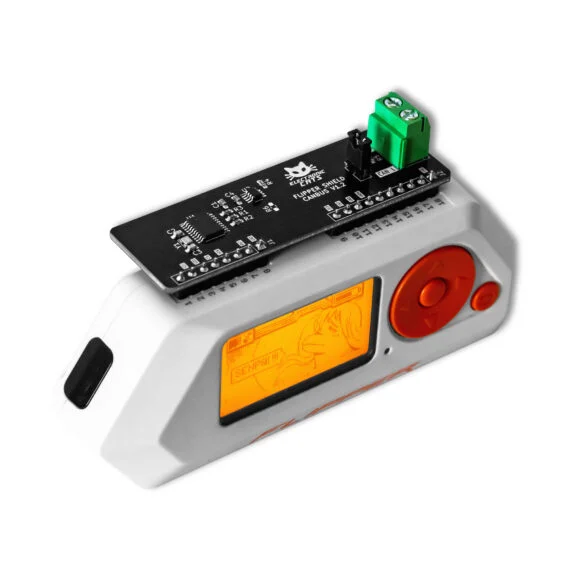
How does CAN bus work?Controller Area Network (CAN), is a special kind of communication system designed for devices to talk to each other. It’s most commonly used in cars where it allows all the electronic control units (ECUs) to chat with each other.Instead of a continuous flow of data, CAN bus sends information in short messages. Each message has an ID that tells the other devices what kind of data it is. This makes it easier to find specific information.Not all messages are equal. Some messages are more important than others. CAN bus lets important messages get sent first, which is crucial in situations like when the anti-lock brakes need to talk to the engine right away.This is one of the coolest things about CAN bus. It only uses two wires to transmit messages.Tech SpecsMCP2515Is a stand-alone Controller Area Network (CAN) controller that implements the CAN specification, Version 2.0B. It is capable of transmitting and receiving both standard and extended data and remote frames. The MCP2515 has two acceptance masks and six acceptance filters that are used to filter out unwanted messages, thereby reducing the host MCU’s overhead. The MCP2515 interfaces with microcontrollers (MCUs) via an industry standard Serial Peripheral Interface (SPI).Operates from 2.7V-5.5V5 mA active current (typical)Can be used as a clock source for other device(s)High-Speed SPI Interface (10 MHz)Read more of its characteristics in the datasheet.SchematicsFind the project files here → FLIPPER_CANBUSUnderstanding Flipper Add‐On: CAN busMain functionsThis Add-On allows you to analyze and view IoT traffic in CAN bus networks. You will be able to analyze the traffic of the signals and even replicate them to control peripherals in a CAN bus network.Connecting your Add-On to FlipperUse the pin headers to plug your Add-On to your Flipper.* The first step for using the CAN bus Add-On is installing the CAN bus app in the Flipper. You can find the instructions here.